 0


 English
 Español
 中文简体
 عربى
Noticias de la industria
Inicio / Noticias / Noticias de la industria / Why Sliding Window Rollers Get Noisy: Bearing Causes, Fixes and Buying Checks

2026-11-17
A sliding window roller that measures 33 dB on an assembly bench and grinds at 57 dB once it is seated in an aluminium frame does not have a generic "bad bearing". It has a specific fault: internal clearance that lets the ball set skate under load, a seal lip running dry against the inner ring, or a cage pocket that has swallowed grit from the sill track. Noise is the cheapest diagnostic signal a roller assembly produces, and on window hardware it points to bearing condition far more reliably than a visual inspection, because the damage that matters sits inside a sealed envelope that nobody opens until the sash starts to drag.
Two working rules separate a fast diagnosis from a parts-swapping exercise. First, classify the sound before dismantling anything: frequency band and repetition rate eliminate half the possible causes in under a minute. Second, treat the roller as a system of tread, bearing, axle and track, because a perfectly good 608 bearing will still howl when the track runs out of parallel by two millimetres.
A dry seal lip screams in the 2 kHz to 4 kHz band. A dented raceway clicks in the low hundreds of hertz and repeats once per revolution. A cage that has picked up debris rattles on start and stop but goes quiet at steady speed. Those three behaviours are mechanically unrelated, yet they are routinely treated as one problem and "fixed" with the same can of spray lubricant.
| Sound | Dominant band | Most likely bearing cause | Field check |
|---|---|---|---|
| Dry squeak or chirp | 2–4 kHz | Starved grease, dry rubber seal lip | Spin the wheel unloaded; the squeak persists without track contact |
| Rhythmic click, once per turn | 300–900 Hz | Single ball dent, brinell mark, hard particle in the raceway | Mark the tread, count clicks per revolution, listen for one loud event |
| Continuous hiss or rumble | Above 1.5 kHz | Raceway waviness, degraded grease, fine contamination | Compare noise loaded against unloaded at the same speed |
| Metallic rattle on start and stop | Broadband, short burst | Excess internal clearance, worn cage pocket | Rock the wheel by hand with the sash lifted clear of load |
| Grinding that grows with load | Broadband, low frequency dominant | Corrosion pitting, embedded debris, flat spot on the tread | Inspect the tread and the track surface before the bearing |
The load comparison in the third row is the single most useful test available without instruments. Run the wheel free of load at a steady speed and note the character of the sound; then press the sash down so the roller carries its working load. A bearing fault that originates in the raceway or the ball set becomes measurably louder under load, while a dry seal lip usually changes character rather than volume, and a tread defect stays almost constant because its source is outside the bearing.
Inside a deep groove ball bearing the sound comes from four distinct places, and each one responds to a different correction. Understanding the mechanism prevents the common mistake of buying a tighter tolerance class when the real problem is a 40-micron particle of sand embedded in the grease.
Surface texture on the raceway acts as a series of tiny ramps that lift each ball as it passes. For window roller sizes such as 608, 626, 6000 and 6200, a raceway roughness below Ra 0.05 micron after superfinishing is achievable and directly reduces tonal noise in the 1 kHz to 2 kHz range. Ball grade matters as much as ring finish: a G10 ball holds diameter tolerance within 0.25 micron and sphericity within 0.25 micron, while a G16 ball roughly doubles that variation and produces an audible beat when several balls of slightly different size share the load zone.
Waviness of a specific order is worse than random roughness. If the raceway carries a wave that repeats close to the number of balls in the bearing, every ball reaches a crest at almost the same moment and the resulting vibration adds together instead of cancelling. That is why two bearings with identical roughness readings can differ by 3 dB to 5 dB in perceived tone.
Radial internal clearance determines how far the ball set can move before the load zone is fully engaged. A 608-size bearing in C0 normally runs with roughly 3 to 8 microns of radial play; C3 raises that to around 11 to 18 microns. In a high-speed motor an extra clearance helps heat dissipation, but a window roller turns at 100 to 400 rpm, generates almost no heat, and gains nothing from C3. What it does gain is a start-and-stop rattle as the ball set crosses the clearance band, plus a louder change of direction at the end of each sash travel.
The cage holds the balls apart and carries almost no load, which makes its clearance easy to neglect. Pocket wear of 50 microns is enough to let each ball strike the pocket wall as it enters and leaves the load zone. The result is a short metallic burst whenever the sash starts moving, followed by silence at constant speed. Grease with the wrong base oil makes this worse: a stiff grease does not release the ball quickly enough, so the cage takes the impact instead of the lubricant film.
Rubber-sealed rollers that sit closed and unloaded for months can develop a dry contact track between lip and inner ring. The first few cycles produce a chirp that fades, then returns after the next long dwell. This is friction, not wear, and it is the one bearing noise that genuinely responds to a drop of oil applied at the seal gap.
A sill track on a coastal building collects sand, plaster dust and insect residue, and every one of those materials is harder than the grease that is supposed to keep them out. Metal-shielded bearings (ZZ) use a non-contact steel shield that leaves a labyrinth gap large enough for particles in the 30 to 80 micron range to enter over a few thousand cycles. Rubber-sealed versions (RS) close that gap with a contacting lip and keep far more debris outside, at the cost of a small friction penalty at low speed.
Once grit reaches the raceway it does not simply pass through. It embeds in the softer of the two surfaces, usually the ball, and then acts as a cutting tool on every subsequent pass. That is why a contaminated bearing gets progressively louder instead of settling at a constant level, and why the wear debris it generates then contaminates the remaining grease. A roller that shows a 6 dB rise over three months of service is almost always in this loop.
Practical countermeasures that hold up in real installations: specify a contacting seal on the track side, keep a 1 mm to 2 mm clearance between tread and track wall so debris can fall away instead of being crushed into the bearing, and clean the track with a dry brush rather than a wet cloth, since water pushes grit into the seal gap.
Grease does three jobs at once: it separates the rolling contacts, it protects the raceway from moisture, and it carries heat away from the load zone. Overfilling breaks the third job and adds churning losses; underfilling breaks the first. For small roller bearings the practical fill is 25 to 35 percent of the free internal space, which corresponds to a thin film visible on the balls but no packed cavity behind the shields.
Base oil viscosity should match the slow, lightly loaded duty of a window roller. A base oil of roughly 60 to 100 cSt at 40 degrees Celsius gives a healthy film at 200 rpm without creating so much drag that the roller skids instead of rolling. Heavier greases rated for large bearings produce exactly the start-and-stop rattle described earlier, because the ball cannot push the grease aside quickly enough.
Channeling behaviour separates a good low-speed grease from a bad one. After the first few dozen revolutions, a well-matched grease forms two clean channels beside the load zone and stays there, leaving the contact lightly filmed. A grease that keeps flowing back into the path gets pushed around on every revolution and generates continuous low-level noise that users describe as a hum rather than a squeak.
Windows are a structure-borne noise problem as much as an airborne one. The tread sits between the bearing and the frame, so it decides how much vibration reaches the aluminium profile and how much is absorbed before it becomes sound. Fitting the same 608 bearing into nylon, polyurethane and steel treads produces three clearly different results in the same track.
| Tread material | Noise behaviour | Load and wear | Typical window use |
|---|---|---|---|
| Nylon (PA6, PA66) | Dampls structure-borne vibration, 3–5 dB quieter than steel at low speed | Moderate load, sensitive to flat spotting under static load | Light residential sliding windows, screens |
| Polyurethane (PU, 80–95 Shore A) | Highest damping, absorbs track irregularities and grit impacts | High abrasion resistance, best where debris is present | Patio doors, heavy sashes, coastal installations |
| Polypropylene (POM) | Hard and tonal, transmits raceway noise efficiently | Excellent dimensional stability, low friction | Precision light-duty tracks, furniture slides |
| Carbon steel | Loudest option, ringing on start and stop | Very high load capacity, requires corrosion protection | Heavy industrial sashes, rarely domestic |
| Stainless steel | Similar to carbon steel but marginally better damped | Corrosion resistant, suitable for wet and coastal service | Shower enclosures, exterior doors, humid climates |
Polyurethane tread is the material that changes noise most decisively, because it deforms slightly under load and spreads contact over a wider patch instead of concentrating force at a single point on the track. That deformation also swallows the small impacts caused by a joint between two track sections, which is a common source of periodic knocking that users mistake for a bearing fault.
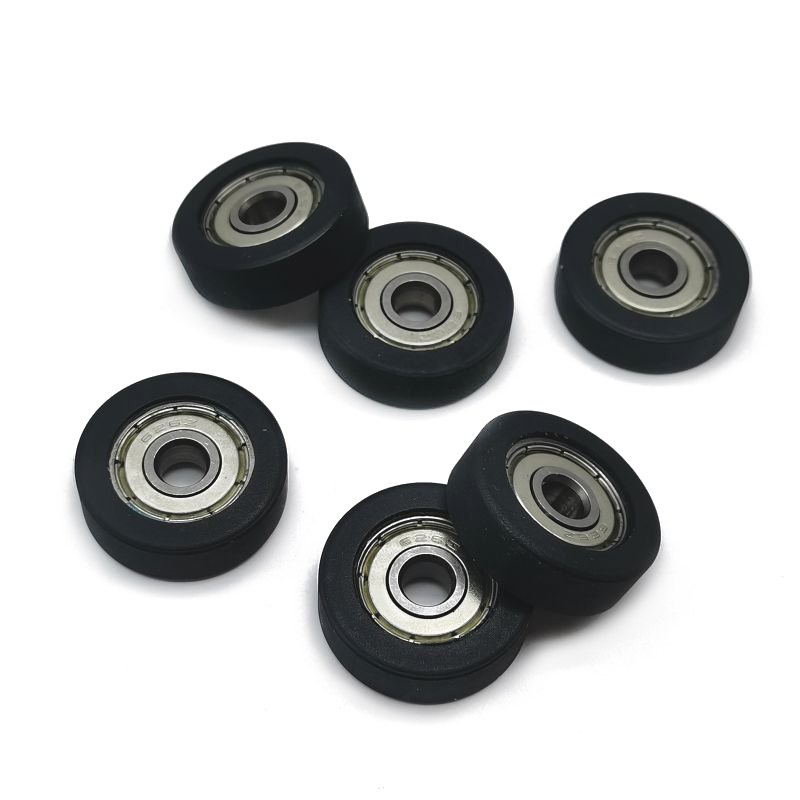 PU62626-8 626ZZ Polyurethane Deep Groove Ball BearingPU outer ring and steel bearing core support high-load rotation; suited to continuous-operation machinery where wear and corrosion resistance reduce maintenance needs.View Product →
Plastic-coated bearings take the same idea one step further: a standard deep groove ball bearing is encapsulated in a moulded shell so the outer surface becomes the rolling tread. The bearing core stays a precision steel component with controlled clearance and a proper seal, while the coating supplies damping and protects the frame from metal-to-metal contact. Coating thickness and bond strength matter more than coating colour, since a shell that separates under load produces a distinct soft knock rather than a metallic noise.
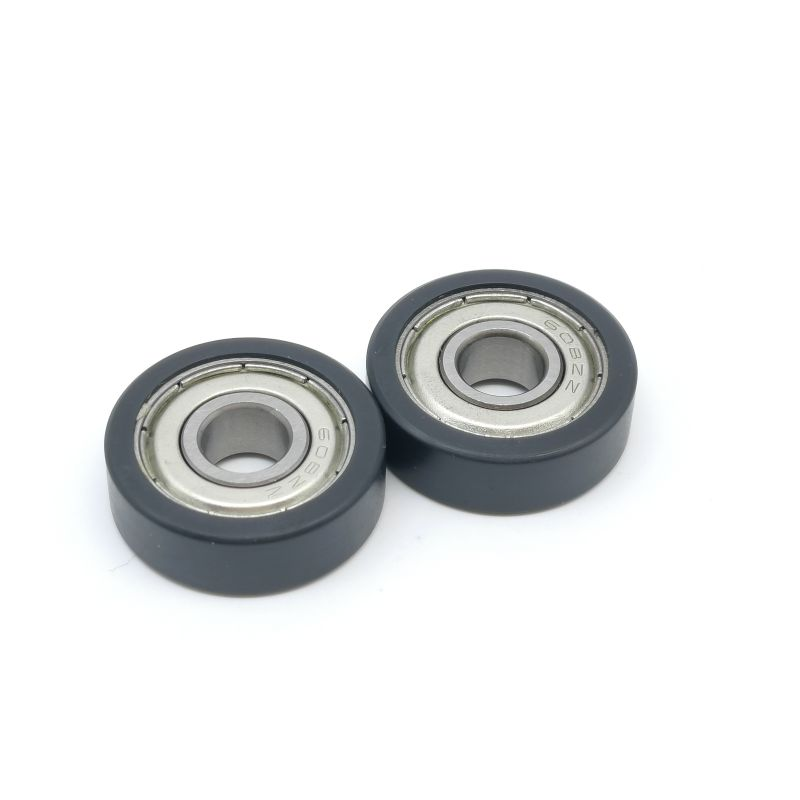 BS60826-8 POM Plastic-Coated Heavy Duty BearingPOM-coated heavy-duty bearing with heat-treated carbon steel rolling element and high-performance grease; relevant for load-bearing industrial machinery and humid environments.View Product →
For window hardware specifically, the practical combination is a plastic-coated or PU-tread roller with a contacting seal on the exposed side and a low-viscosity grease matched to slow rotation. Assemblies built this way typically sit 4 dB to 7 dB below an equivalent all-steel roller in the same track, which is the difference between a sash that is noticed and one that simply moves. Buyers evaluating this construction can review the range of plastic coated bearings for windows to compare coating diameters against standard track profiles.
A large share of warranty claims on window rollers are filed against the bearing when the actual defect is geometry. Misalignment forces the ball set against the shoulder of the raceway, reduces the load zone to a narrow arc, and raises contact stress by an order of magnitude compared with a centred load. The noise that follows is indistinguishable from a worn bearing to anyone listening at the frame.
A quick geometric check costs ten minutes: run the sash slowly by hand, mark the frame position where the noise peaks, and repeat at a second position along the track. If the noise follows the position rather than the roller, the fault is in the track. If it follows the roller as you rotate the sash, the fault is in the assembly.
The order matters because each step removes possibilities for the next one. Skipping straight to lubrication hides evidence and often adds a new problem, since oil can wash grease away from a contact that was marginal.
Not every noisy roller needs replacing, and not every roller that can be quietened should be kept. The table below sets out what each intervention actually achieves, based on comparisons of the same 608-2RS roller before and after treatment at 200 rpm under a 40 N load.
| Intervention | Addresses | Realistic noise drop | Durability of the fix |
|---|---|---|---|
| Dry clean of track and tread | Grit, hair, plaster dust | 4–8 dB | Weeks to months, depends on environment |
| One drop of low-viscosity oil at the seal | Dry lip, starved contact | 2–5 dB | Days to weeks, temporary |
| Re-grease with matched base oil | Channeling, wrong grease stiffness | 3–6 dB | Months if the seal is intact |
| Replace bearing in existing tread | Raceway damage, clearance wear | 6–12 dB | Full service life |
| Replace complete roller with sealed PU or coated unit | Everything above, plus damping | 8–15 dB | Full service life, best long-term result |
| Re-align or replace track section | Side load, geometric faults | 5–10 dB | Permanent |
The last row deserves emphasis. Replacing a bearing in a misaligned frame simply moves the failure forward by a few months, and the second failure is usually louder than the first because the new bearing starts with a full grease charge and no wear-in.
Laboratory measurement separates faults that sound similar in a workshop. The chart below shows the A-weighted increase above a clean, correctly lubricated baseline for the same roller size and load.
Speed dependence matters as much as fault type. Tonal faults scale predictably with rotation, while seal friction tends to plateau once the lip has bedded in. The second chart shows how a correctly sealed roller behaves across the working speed range of a residential sash.
Two conclusions follow. First, a 10 dB gap between two rollers in the same frame is not measurement noise; it is a real material or lubrication difference that users will hear and complain about. Second, above roughly 240 rpm the roller itself becomes a minor contributor compared with tread vibration, which is why high-speed sliding systems benefit more from damped treads than from tighter bearing tolerances. Bearing designs built around low noise deep groove construction typically combine superfinished raceways, tighter ball grading and controlled grease fill to keep the baseline low across this whole range.
Noise complaints usually begin with an underspecified purchase order. A roller described only as "608 bearing, nylon wheel" leaves every variable that determines sound open to the supplier's discretion, and price pressure then removes the finishing steps that keep it quiet.
State the test method, not just a number: A-weighted level at 30 cm, at a defined speed and load, with background noise below 25 dB, measured on a stated sample size. A limit without a method cannot be enforced.
Specify contacting rubber on the track-facing side and a shielded or open inner side where grease retention allows it. Mixed sealing lowers drag without exposing the raceway.
C0 for window and furniture duty. Reserve C3 for applications with genuine thermal expansion, since extra clearance in a slow roller shows up as rattle rather than as thermal margin.
For polyurethane specify 80 to 95 Shore A; for coated shells specify coating thickness tolerance and a pull-off check, because a loose shell produces a soft knock that reads as a bearing fault.
Control radial runout at the tread and bore tolerance at the axle. A loose bore lets the roller oscillate on the shaft, adding an impact once per revolution that no bearing upgrade can remove.
Name the base oil viscosity and thickener, and state the operating temperature range. Anonymous "high quality grease" is the most common reason two shipments of the same part sound different.
Window type drives load, exposure and acceptable noise more than any single component decision. The four groupings below cover most residential and light commercial demand.
A 608 or 626 bearing in a nylon tread, C0 clearance, shielded on the inner side and contacting-sealed outward. Target baseline below 40 dB at 150 rpm; keep tread diameter within 0.05 mm to avoid rocking.
Larger 6200 and 6201 sizes, polyurethane tread for damping and abrasion resistance, and a double-sealed bearing to survive track debris. Load per roller commonly reaches several hundred newtons, so clearance control matters more than raw load rating.
Stainless rings and balls resist pitting that would otherwise generate grinding noise within a season. AISI 440C gives hardness and corrosion resistance together; AISI 304 suits lighter loads with maximum chemical resistance.
Miniature sizes such as 683, 693 and MR series, plastic-coated for quiet running on thin aluminium profiles. Low mass means low inertia, so grease stiffness dominates the sound more than bearing geometry.
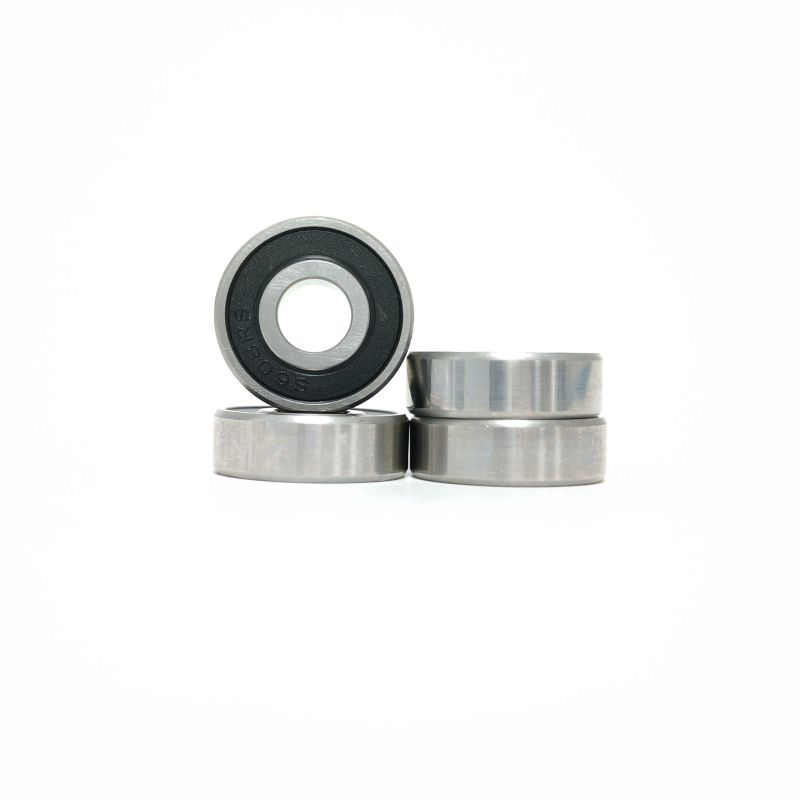 S608RS Stainless Steel Deep Groove Ball BearingStainless steel bearing with double rubber seals and low-noise running; relevant for humid, corrosive or noise-sensitive equipment such as food processing and medical devices.View Product →
In humid service the seal choice outweighs almost everything else. A stainless bearing with a rubber seal keeps moisture away from the raceway and prevents the rust film that turns a smooth surface into a grinding paste; the same bearing with only a metal shield often fails quietly at first and then becomes noticeably rough once pitting starts.
Cold thickens the grease base oil and shrinks the housing slightly, both of which reduce the film thickness at the ball contact and increase friction at the seal lip. A grease with a low pour point and a base oil viscosity matched to slow rotation removes most cold-start squeak. If the noise disappears after a minute of use, the bearing is intact and only the lubricant is mismatched.
Yes, within limits. Clean the track with a dry brush, then apply a small amount of low-viscosity oil at the seal gap and cycle the sash several times. This treats a dry lip or a starved contact and typically buys weeks of quiet operation. It will not repair a dented raceway, and it will not remove grit that has already embedded in the ball surface.
Consistently yes, by roughly 3 dB to 7 dB in the same track. The coating damps structure-borne vibration before it reaches the frame and absorbs small track irregularities. The bearing inside still determines tonal quality, so a coated roller with a poor bearing can sound worse than a plain roller with a good one.
C0, which for a 608-size bearing means roughly 3 to 8 microns. Window rollers run slowly and generate little heat, so the thermal argument for extra clearance does not apply. A C3 bearing in this duty often produces a rattle at start and stop that users report as a loose or broken part.
A single local defect: a brinell dent from an impact during assembly, one embedded hard particle, or a flat spot on the tread. Mark the wheel, rotate it slowly, and confirm the click aligns with the same angular position each turn. Bearing replacement resolves the first two; tread replacement resolves the third.
At low speed a dry rubber lip adds 2 dB to 4 dB of friction noise compared with a metal shield. In contaminated service the comparison reverses within weeks, because the shielded bearing ingests grit and becomes far louder than the sealed one. The seal is a noise decision only in clean, dry, low-dust environments.
Replace it when the noise returns within a few weeks of lubrication, when hand rocking shows more than about 0.1 mm of play, when the tread shows a flat spot, or when any corrosion is visible at the seal. These conditions indicate surface damage that no lubricant can reverse.
Fix the method before comparing results: same speed, same load, same measurement distance, A-weighted, background below 25 dB, minimum five samples per batch. Ask for the raw values rather than a pass or fail statement, and check whether the reported figure is an average or a maximum, since the loudest unit in a batch is the one that generates the complaint.
Productos
CONTÁCTENOS
Sitio móvil
Derechos de autor © Zhejiang Yingfei Biotechnology Co., Ltd.Reservados todos los derechos
 Fábrica de rodamientos para vehículos de motocicletas y automóviles al por mayor